The cabinet style you choose sets the tone for your entire kitchen. Everything else, countertops, hardware, and lighting, flows from that one decision. So when you’re weighing shaker-style cabinets vs flat panel, you’re really choosing the personality of the whole space.
Good news: both are strong options. They just serve very different kitchens and very different homeowners. This article breaks down the design elements, cost considerations, maintenance realities, and customization options for each, so you can make that call with confidence.
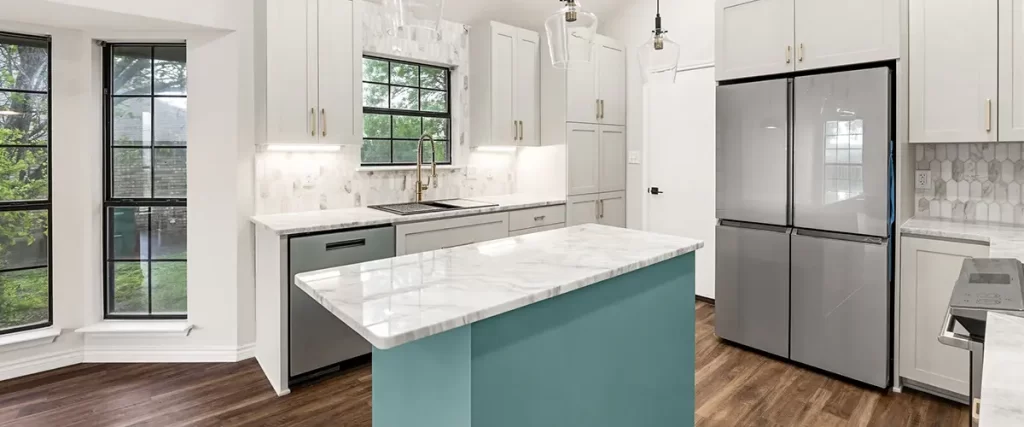
Quick Comparison: Shaker Cabinets vs Slab Cabinets
Shaker kitchen cabinets feature a five-piece door with a recessed center panel framed by four clean rails. The look is structured and warm, and it works across traditional and contemporary styles with equal ease.
Ideal for: Traditional-style kitchens, farmhouse layouts, transitional spaces, and homes built with warm, natural materials.
Flat-panel kitchen cabinets (also called slab cabinets) have a single, smooth door surface with no framing or decorative elements. Their sleek simplicity is the whole point, and it works beautifully in modern and contemporary designs.
Ideal for: Modern kitchens, open-plan contemporary interior designs, industrial-inspired designs, and minimalist homes.
Rule of thumb: If your home has character and warmth, shaker. If your home leans towards modern architecture and clean geometry, go for a flat panel.
What Are Shaker-Style Cabinets?
The defining feature of shaker cabinets is the five-piece construction: a recessed center panel surrounded by a flat frame with clean lines and no ornate detailing. No intricate designs, no decorative elements competing for attention. Just good structure.
Common materials for shaker doors include:
- Solid wood in different wood species like maple, oak, hickory, and cherry
- MDF, especially popular for painted shaker cabinets
- Plywood with a veneer face
Shaker kitchen cabinets are available in painted, stained, and glazed finishes. White and off-white remain the most popular, but deep navy, sage green, and warm charcoal are all common in current kitchens.
Hardware choices typically include cup pulls, bin pulls, bar pulls, and simple knobs, all of which complement traditional and contemporary designs equally well.
What Are Slab (Flat-Panel) Cabinets?
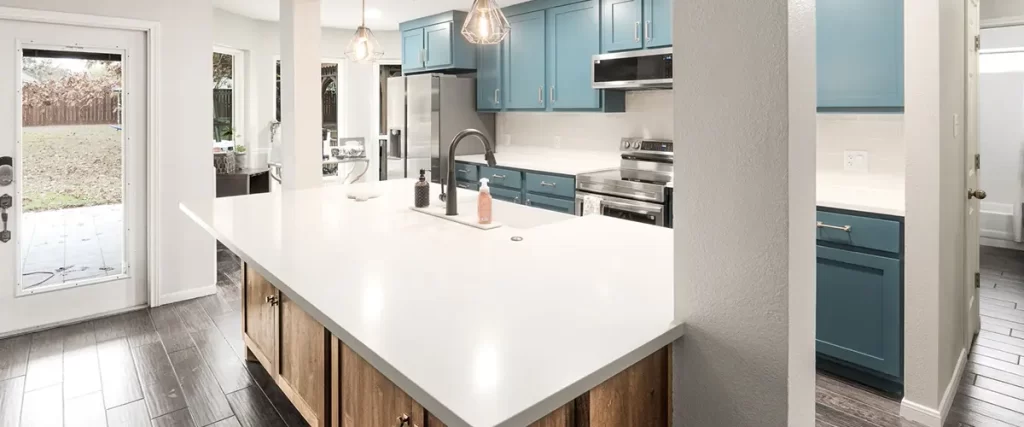
Flat-panel cabinets embrace a different design philosophy. Each door is a single flat surface with straight edges and no raised, recessed, or framed panels.
The absence of detail is the design statement. This minimalist aesthetic fits naturally into contemporary styles, Scandinavian interiors, and industrial-inspired designs.
Flat panel cabinets require a higher standard of material quality because there’s nothing on the surface to distract from imperfections. Common materials include:
- Wood veneer with visible grain direction
- High-gloss or matte lacquer over MDF
- Laminate and thermally fused laminate (TFL)
- Acrylic panels for a very high-gloss modern appearance
The hardware trend for flat cabinets leans hard toward integrated J-channel pulls routed directly into the door edge, or push-to-open mechanisms that maintain that unbroken flat surface.
When visible hardware is used, it typically has a low profile to preserve a modern, minimalist look.
Practical Factors: Cost, Durability, and Maintenance
Here’s the side-by-side most homeowners want to see before anything else.
| Factor | Shaker Cabinets | Flat Panel Cabinets |
| Typical cost (per linear ft) | $100–$650+ (stock to semi-custom); up to $1,200 custom | $70–$300 (stock/mid-range); high-gloss lacquer can exceed shaker pricing |
| Construction complexity | Higher (5-piece frame) | Lower (single panel) |
| Most common materials | Solid wood, MDF | Laminate, veneer, acrylic, MDF |
| Cleaning effort | More, grooves collect grime | Easy wipe-down surface |
| Durability | Excellent with high quality materials | Good with quality materials |
| Style staying power | Timeless charm | Trend-dependent at the extremes |
Shaker cabinets generally cost more due to their multi-piece door construction. That said, at comparable quality levels, the price gap between shaker vs flat panel is often only 5-10%.
High-gloss lacquer flat panel cabinets, which require multiple spray coats and flawless surface prep, can actually exceed painted shaker pricing at the same quality tier.
Durability-wise, both hold up well when made from high quality materials. Solid wood shaker doors are among the most durable cabinet doors available. MDF flat panel doors are notably more vulnerable to moisture, especially at the edges.
However, shaker cabinets require more maintenance. The recessed center panel and frame grooves trap dust, grease, and grime over time. Flat panel cabinets, with their smooth surfaces and no crevices, can be wiped down in seconds.
Customization Options and Finish Choices
Design options for shaker cabinets are genuinely broad. You can customize shaker cabinets in paint, stain, glaze, or veneer. You can choose between inset, partial-overlay, and full-overlay configurations, and order custom sizing for any kitchen layout.
Flat panel designs offer a strong set of options: matte, satin, and high-gloss finishes, solid colors, wood-grain veneers, and even textured surfaces. Both door styles support open-shelf integration, which is a popular design choice right now.
Hardware pairings worth considering:
- Shaker: Aged brass bin pulls, matte black bar pulls, simple ceramic knobs
- Flat panel: Integrated J-channels, push-to-open hardware, thin metal bar pulls
Glass front cabinets also pair well with shaker uppers when you want to break up a long run of solid doors.
Styling Options for Modern and Traditional Kitchens
Shaker cabinets offer a better fit for traditional style kitchens, transitional designs, and homes with warm, natural textures throughout. The recessed panel adds character without overpowering the space. They also complement traditional countertop materials like butcher block, honed marble, and natural stone beautifully.
Flat-panel cabinets offer the right look for modern kitchens and for any kitchen leaning toward a minimalist design. They work with engineered quartz, polished concrete, and large-format tile in ways shaker doors can’t quite match.
For transitional or mixed-style projects, a popular approach is to mix shaker uppers with flat panel lowers. The upper cabinet keeps the warmth and depth of the shaker style, while the lower cabinets stay simple and easy to clean.
Alternative Cabinet Styles
If neither style fully fits your desired style, a few alternatives are worth knowing:
- Raised panels for formal, traditional kitchens with more ornate detail
- Beadboard doors for cottage and coastal interiors
- Glass front cabinets as accent uppers in both shaker and flat panel kitchens
Decision Checklist: Choose the Right Cabinet Style
Before committing to either style, work through this:
- How much kitchen traffic does your household generate daily? High traffic favors flat panel’s easy-clean surface.
- Set a clear budget range before design choices start, not after.
- Be honest about your cleaning habits. Shaker cabinets require more maintenance.
- Are you planning to sell in the next few years? Shaker cabinets have broader resale appeal across interior styles.
- Look at your existing countertops, flooring, and hardware. Your cabinet doors need to work with what’s already there.
- Order door samples and photograph them in your actual kitchen lighting before making a final call.
Manufacturers like KraftMaid offer door sample programs specifically so you can test different door styles and finishes under real conditions.
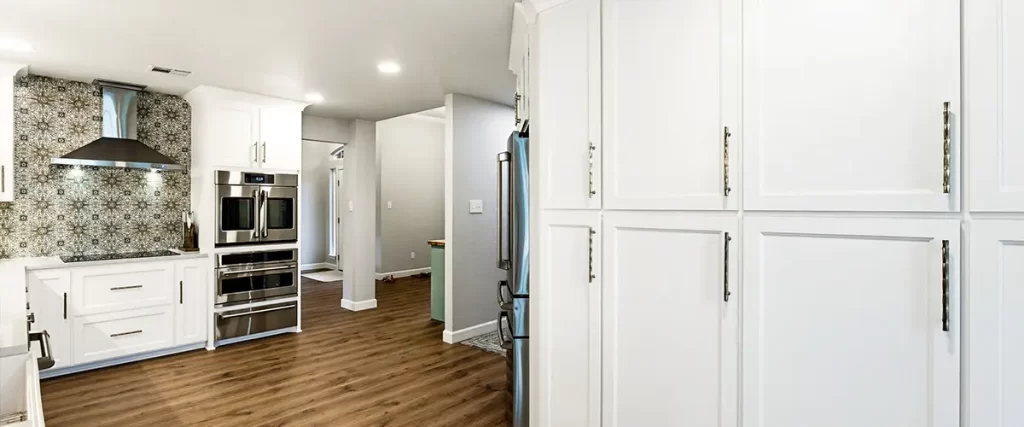
FAQ: Shaker-Style Cabinets vs. Flat Panel
Can a shaker cabinet achieve a modern look?
Yes. Shaker cabinets offer plenty of room to go modern with the right choices. Two-tone finishes, integrated hardware, and slab-style drawer fronts paired with shaker doors upstairs are a popular transitional move. The clean lines of the shaker door style hold up well in contemporary interior designs.
Are flat-panel cabinets cheaper in the long term?
Generally, yes, when using laminate or MDF flat panel cabinet doors. Flat panel cabinets require less labor to construct than shaker, and their smooth surfaces make refinishing easier. High-gloss lacquer flat panel designs are the exception and can match or exceed shaker pricing.
How do you mix styles without clashing?
Keep your finish colors consistent when mixing shaker and flat-panel doors in the same kitchen. Use one as a feature run and the other as a supporting element. Matching hardware across both door styles is the easiest way to tie the look together.
You Don’t Have To Decide Alone
Choosing between shaker-style cabinets and flat-panel cabinets is one of those decisions that sounds simple until you’re sitting in a showroom juggling door samples, finish options, and hardware combinations against everything else in a kitchen remodel.
The team at Gill Construction has walked over 2,000 Central Texas families through exactly this process, from Bell County to Harker Heights, Belton, Temple, and beyond.
We handle the design-build process start to finish, which means you don’t have to figure out which cabinet style suits your kitchen layout, countertops, and budget on your own.
Call us at or message us here, and let’s talk through your kitchen.