The custom cabinets vs stock cabinets decision comes down to one question: does your kitchen have odd dimensions or standard ones?
Stock cabinetry is manufactured in fixed sizes and priced accordingly. Custom cabinets are built to your walls, cost more, and waste zero space.
Most Central Texas kitchens can go either way. The categories below are where the difference shows up:
| Stock Cabinets | Custom Cabinets | |
|---|---|---|
| Typical cabinet spend | $3,000 to $8,000 | $25,000 and up |
| Sizing | Fixed three-inch increments | Built to your walls |
| Lead time | Fastest, often in stock | Longest, built after approval |
| Box construction | Often particleboard or MDF | Typically plywood |
| Door styles and colors | Limited catalog | Effectively unlimited |
| Interior features | Basic shelving | Designed around your kitchen |
Before you go either direction, there’s also a middle tier worth knowing about: semi-custom cabinets. But before we get to that third option, let’s compare these two options in detail.
Cost
Cabinetry is usually the largest line item in a kitchen budget, and the range can be wide.
In our projects, stock cabinets generally land between $3,000 and $8,000, while full custom starts around $25,000. Both sit inside overall kitchen remodels of $18,000 to $100,000 and up.
The higher number buys better fit and construction quality.
Fit and Sizing
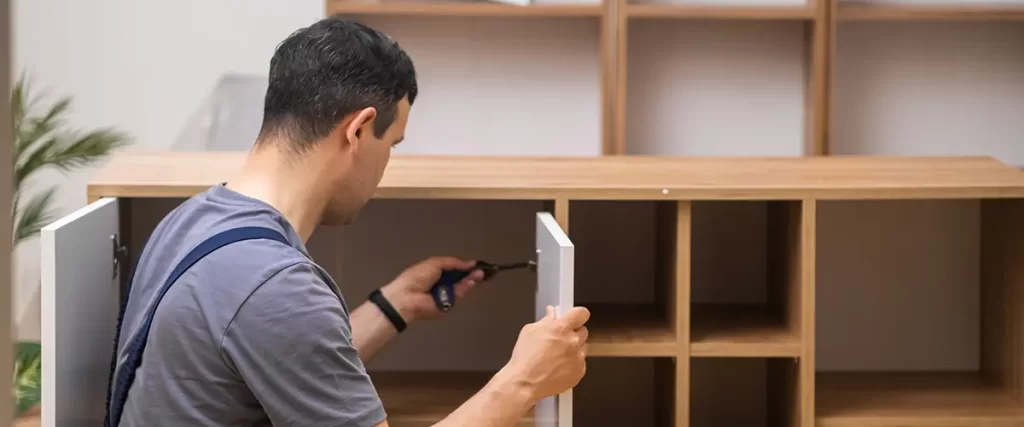
Stock lines are built in three-inch width increments, so your kitchen gets fitted to the nearest box and the leftover inches get covered with filler strips.
In a long, regular run, that’s barely noticeable. In a galley kitchen or a space with a bumped-out chimney, those fillers can eat a foot of storage.
Custom cabinetry is measured to the actual wall, including the out-of-square corners older Central Texas homes have plenty of.
Lead Time
Stock wins here without much argument.
Many stock lines sit in a warehouse and arrive in days or a couple of weeks. Custom is built from scratch after your drawings are approved, which adds weeks before anything ships.
If a move-in date or a family event drives your schedule, a quick lead time may make the choice for you.
Materials and Construction
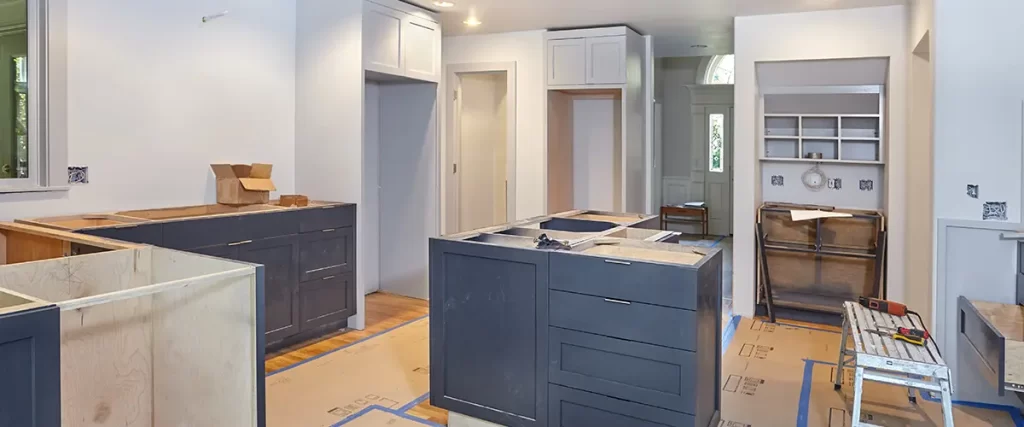
Quality shows in the box. Stock boxes commonly use particleboard or MDF with a laminate skin. Custom shops typically build plywood boxes with dovetailed drawers and solid hardwood face frames.
Keep in mind that composite panels aren’t automatically a problem. Under TSCA Title VI, hardwood plywood, MDF, and particleboard in finished goods like cabinets must meet federal formaldehyde emission standards and carry compliant labeling.
Style and Finish Options
Stock catalogs offer a limited set of door styles and color options, which can help when decision fatigue sets in.
Meanwhile, custom gives you complete control to go after the look you want: you pick the wood species, the paint or stain colors, and the door profile.
See our breakdown of Shaker-style cabinets, one of the most popular door profiles.
Storage and Interior Features
Stock cabinets come with adjustable shelves and standard drawers. Add-ons exist, but they’re catalog items that have to fit the standard box.
Custom is where storage issues get truly solved. You can get a pull-out pantry sized to your cans, drawers deep enough for stock pots, or appliance garages that hide counter clutter.
In a small space, that’s the strongest argument for spending up.
Durability
Both options last a long time when the installation work is done well. The difference shows in the moving parts and the moisture zones.
Plywood handles a dishwasher leak better than particleboard, and full-extension soft-close hardware outlasts basic slides by a wide margin.
Going stock? Put the upgrade money into hinges and glides. It buys more longevity than the door style will.
Resale Value
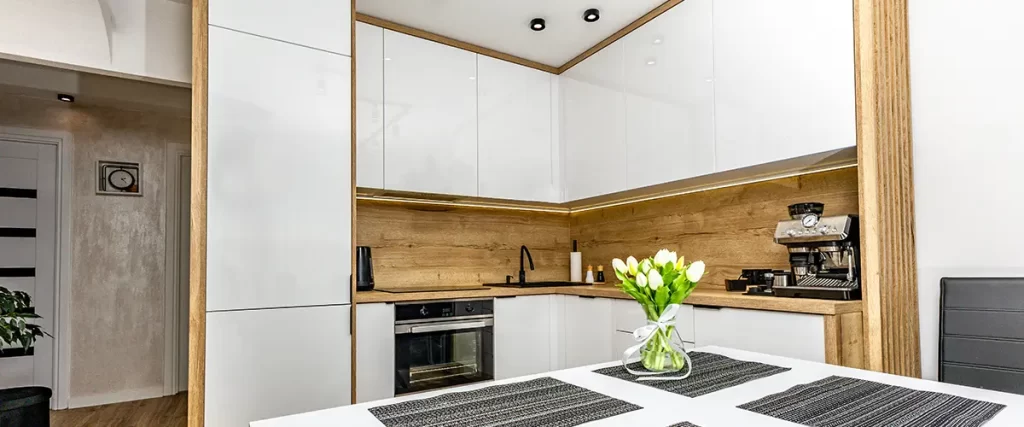
Buyers notice a kitchen that fits its space. Cabinetry running to the ceiling with no awkward gaps reads as intentional, and good design achieves that within any tier.
Custom pays off most in higher-end homes where a stock kitchen looks undersized.
Semi-Custom: The Middle Ground Most Kitchens Land On
The comparison above leaves out the tier most homeowners actually buy.
Semi-custom sits between the two and solves the specific problems that push people toward custom in the first place.
You get catalog cabinets in standard sizes, with real modification available: adjusted depths and heights, a much wider selection of colors and finishes, and most of the interior organizers.
Typical spend runs $8,000 to $20,000, and lead time lands in the middle, since the order goes into a production queue.
FAQ
Can I mix stock and custom cabinets in one kitchen?
Yes, and it’s a smart budget move. Use stock on the long, regular perimeter walls and go custom on the island or the one tricky corner where fit matters. Matching colors across both takes a careful eye, so handle it during design.
Are custom cabinets worth it in a small kitchen?
Usually, yes. Small kitchens benefit most because custom cabinets remove filler space and maximize storage.
Do cabinets have to be ordered before demolition?
They should be. Cabinet lead time drives the whole schedule, and gutting a kitchen before the boxes are confirmed is how 4-week projects become 10-week ones.
Talk to the People Who Upgrade Cabinets Every Week
Call us at or message us here. We’ll show you what stock, semi-custom, and custom cabinets can look like in your actual space, with a fixed cost for all three options.
Our kitchen remodeling service covers design, cabinetry, and installation with a 5-year workmanship warranty.