Shaker-style cabinets are the single most popular cabinet choice in American kitchens right now, and they have been for years. Simple, clean, and incredibly adaptable, they work in a farmhouse kitchen just as well as a sleek modern one.
But a lot of homeowners aren’t sure exactly what makes a cabinet “shaker” or how to make smart decisions when shopping for them. This guide covers everything, from where they came from to door styles, materials, hardware, and what to budget for.
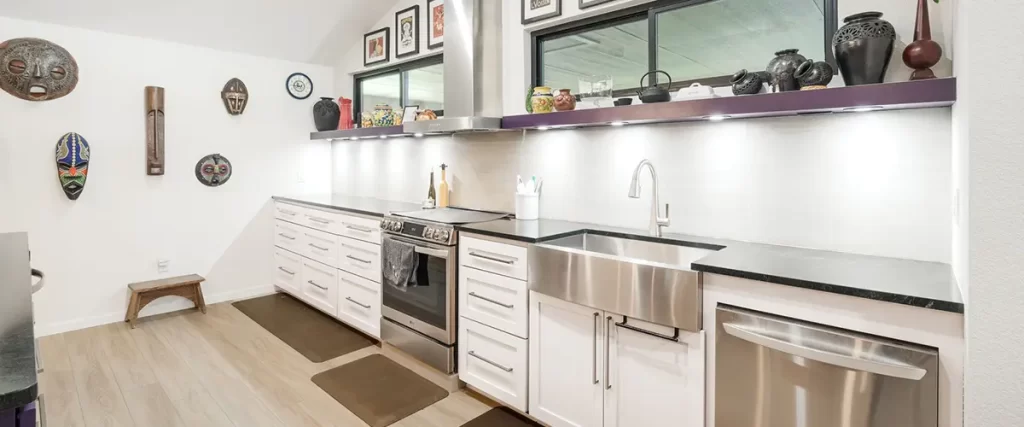
Why Is It Called “Shaker”?
The history of shaker cabinets starts in 1774, when a group of English Quakers emigrated to America in search of religious freedom and a simple, communal lifestyle.
Their habit of ecstatic movement during worship earned them the nickname “Shaking Quakers,” which later shortened to “Shakers.”
Their core values, including humility, simplicity, and hard work, are reflected directly in the design language of their furniture and cabinetry. For the Shakers, a door was beautiful because it was well-made and served a purpose, not because it was ornate.
The name “shaker” for this style of furniture was given by the United Society of Believers in Christ’s Second Appearing, whose association was originally formed in Manchester, United Kingdom.
As their communities spread across New England and beyond, so did their distinctive furniture, and the quality pieces they made came to be known simply as shaker cabinets.
Shaker Cabinets vs. Other Cabinet Styles
To understand what makes shaker cabinets special, it helps to compare them with other options.
- Raised-panel cabinets are the traditional alternative. The center panel is raised, creating a dimensional, ornate look. They suit formal or heavily traditional kitchens, but can feel heavy in modern spaces.
- Slab cabinets have no frame and no panel, just a flat door. Very contemporary, very minimal. They’re sleek but can feel cold if the rest of the design isn’t intentional.
Shaker cabinets sit right in the middle. They have structure and detail through the rail-and-stile frame, but they’re clean enough to work in nearly any kitchen style.
If you’re comparing the two most common modern cabinet looks, our guide to shaker vs flat-panel cabinets breaks down the visual differences, cost factors, maintenance, and best-fit kitchen styles.
Key Features of Shaker Cabinet Doors
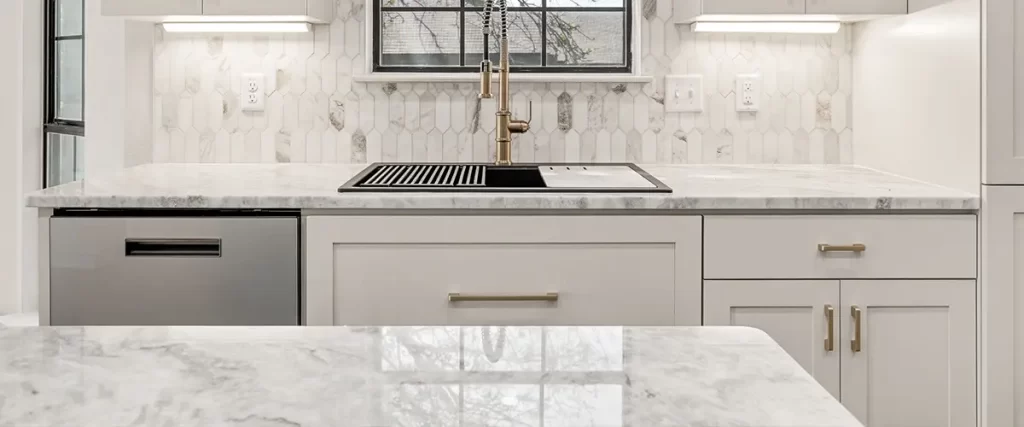
A shaker cabinet door is built with cope-and-stick construction, featuring a simple recessed center panel, typically 1/4 inch deep. The frame edges are clean and square, giving the door a refined yet understated look.
The recessed panel is really the defining characteristic. It creates a subtle shadow line that adds visual interest to the cabinet without competing with anything else in the room.
Because the surface is mostly flat with no curves or intricate profiles, they’re also very easy to clean, which is no small thing in a working kitchen.
Common Shaker Door Styles
There’s more variety within shaker than most people expect:
- Five-piece framed shaker doors — the classic. Four frame pieces around a flat recessed panel. This is the standard shaker look you’ll see most often.
- Slab shaker doors — a frameless variation that strips away the rails and stiles for a cleaner, more minimalist look. Sometimes called “flat panel” doors. Best for contemporary or transitional kitchens.
- Inset shaker doors — the doors sit flush inside the cabinet frame rather than overlapping it. The result is a furniture-like, built-in appearance. It’s a more precise build and typically costs more.
- Full-overlay shaker doors — doors cover most of the cabinet face frame, minimizing the gaps between doors. A popular choice because it maximizes visual coverage and feels very tidy.
Materials and Finishes
Here’s a quick breakdown of the most common options:
| Material | Best For | Notes |
| Maple | Painted finishes | Tight grain, takes paint beautifully |
| Cherry | Stained cabinets | Rich color, darkens naturally over time |
| Oak | Traditional and rustic kitchens | Pronounced grain, very durable |
| Birch | Budget-friendly solid wood | Smooth, stable, paints well |
| Walnut | High-end or contemporary kitchens | Dark, dramatic grain |
| MDF | Painted cabinets on tighter budgets | No grain, ultra-smooth painted surface |
If you’re going with a painted finish, paint-grade maple or MDF will give you the smoothest result. For stained cabinets, cherry and walnut are standouts because their natural grains tell a story on their own.
Budget, Cost, and Custom Shaker Cabinets
The final cost largely depends on how custom you go:
- Stock shaker cabinets can start around $100 per linear foot for uninstalled units, though installed costs typically run $100 to $400 per linear foot.
- Semi-custom ranges from roughly $150 to $650 per linear foot.
- Full custom work starts around $500 and can go well beyond $1,200 per linear foot depending on the wood species, finish, and construction method.
MDF is the more affordable option for painted cabinets and performs well, but solid wood holds up better over time and adds more value. If your budget allows, solid wood or plywood construction is usually worth the difference.
Always get multiple quotes and ask specifically about box material, hinge brand, and drawer construction.
Construction and Craftsmanship
Not all shaker cabinets are built the same, and it’s worth knowing what to look for.
Framed construction means there’s a solid wood face frame attached to the front of the cabinet box. This is the traditional American method and adds rigidity and a classic look.
Frameless (European) construction eliminates the face frame for a cleaner interior and slightly more storage space. Common in modern shaker kitchens.
When evaluating cabinet quality, look for these specifics:
- Dovetail drawer boxes — the gold standard for drawer joinery. Strong, precise, and a reliable sign that care went into the build.
- Hardwood face frames over particle board
- Plywood cabinet sides, not MDF or particleboard, for better long-term stability
- Soft-close hinges and drawer slides that are adjustable
Shaker Kitchens Across Home Styles
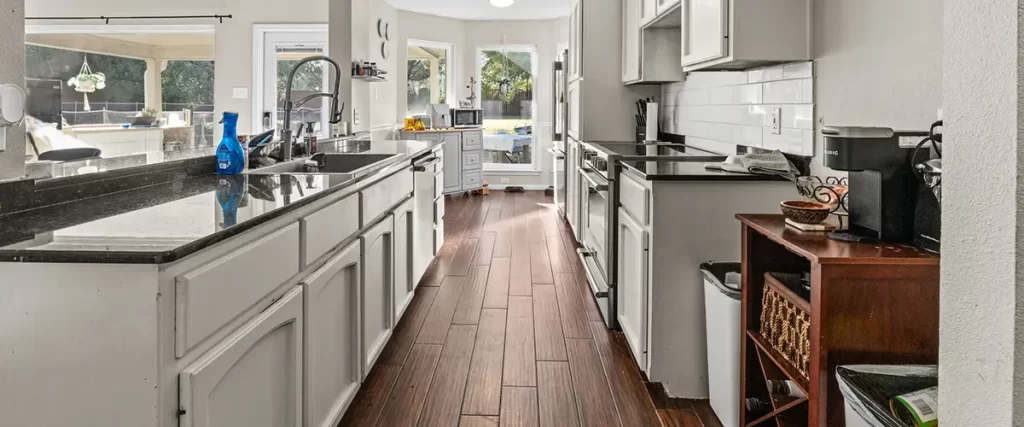
One of the best things about shaker cabinetry is how well it adapts. A few pairing ideas:
- Modern farmhouse — white shaker cabinets, open shelving, butcher block island, matte black hardware, subway tile backsplash. Warm and unpretentious.
- Transitional — two-tone shaker cabinets (navy or sage lowers, white uppers), quartz countertops, mixed metal hardware. This is one of the most requested looks right now.
- Contemporary/minimalist — shaker cabinets in a muted tone like greige or charcoal, integrated hardware or thin bar pulls, and a seamless quartz countertop. Clean and sophisticated.
Installation and Maintenance Tips
- Inset doors require professional installation. The tolerances are tight and proper alignment takes experience.
- Clean painted shaker cabinets with a mild soap-and-water solution. Harsh cleaners will break down the finish over time.
- Do a seasonal check on hinges and soft-close hardware, especially if your home experiences humidity swings. Adjustments take minutes and prevent bigger issues.
Pros and Cons of Shaker Cabinets
Pros:
- Timeless aesthetic that holds resale value well
- Works across virtually every kitchen design style
- Hardware can be easily swapped to update the look
- Easy to clean and maintain
Cons:
- The recessed panel can collect grease and dust in high-use cooking environments
- Inset versions cost significantly more
- May feel too simple for homeowners who prefer ornate, decorative cabinetry
- Quality and cost vary widely depending on construction and materials
FAQ: Shaker-Style Cabinets
Are shaker cabinets still in style for 2025 and 2026?
Yes, absolutely. They’ve been the dominant cabinet style in American kitchens for over a decade and show no signs of fading. Their adaptability is the reason. You can make a shaker kitchen feel traditional or ultra-modern just by changing the colors and hardware.
What’s the difference between inset and full-overlay shaker doors?
Inset doors sit flush inside the cabinet frame, giving a furniture-like appearance with visible hinges. Full-overlay doors sit in front of the frame and cover most of it, creating a clean, streamlined look. Inset is more expensive due to the precision required in manufacturing and installation.
What hardware looks best on shaker cabinets?
That depends on the kitchen style. Matte black hardware suits modern and farmhouse kitchens. Brass is popular in transitional designs. Brushed nickel is a safe, versatile choice. Avoid anything too ornate, as it tends to compete with the clean lines.
Do shaker cabinets add resale value?
Yes. Their broad appeal means shaker kitchens are attractive to a wide range of buyers. A well-executed shaker kitchen with quality materials and good layout is one of the safer remodeling investments you can make.
Can I paint existing cabinets to look like shaker style?
You can add shaker-style trim to flat slab doors to create a similar profile, but the result isn’t identical to true shaker construction. If you’re already considering a remodel, new shaker cabinet doors or full cabinet replacement usually give a cleaner, more professional result.
Ready to Stop Researching and Start Building?
Everything in this guide is useful to know, but pulling it all together, finding the right materials, matching hardware to countertops, navigating inset vs. overlay, managing installation, and staying on budget, takes a lot of time and coordination. That’s exactly what a professional remodeling team handles for you.
The team at Gill Construction has transformed over 50 kitchens across Bell County and Central Texas, handling everything from design to final install with a 5-year workmanship warranty. You don’t have to figure all of this out on your own.
Call us at or message us here and we’ll take it from there.